About Weigh-In-Motion
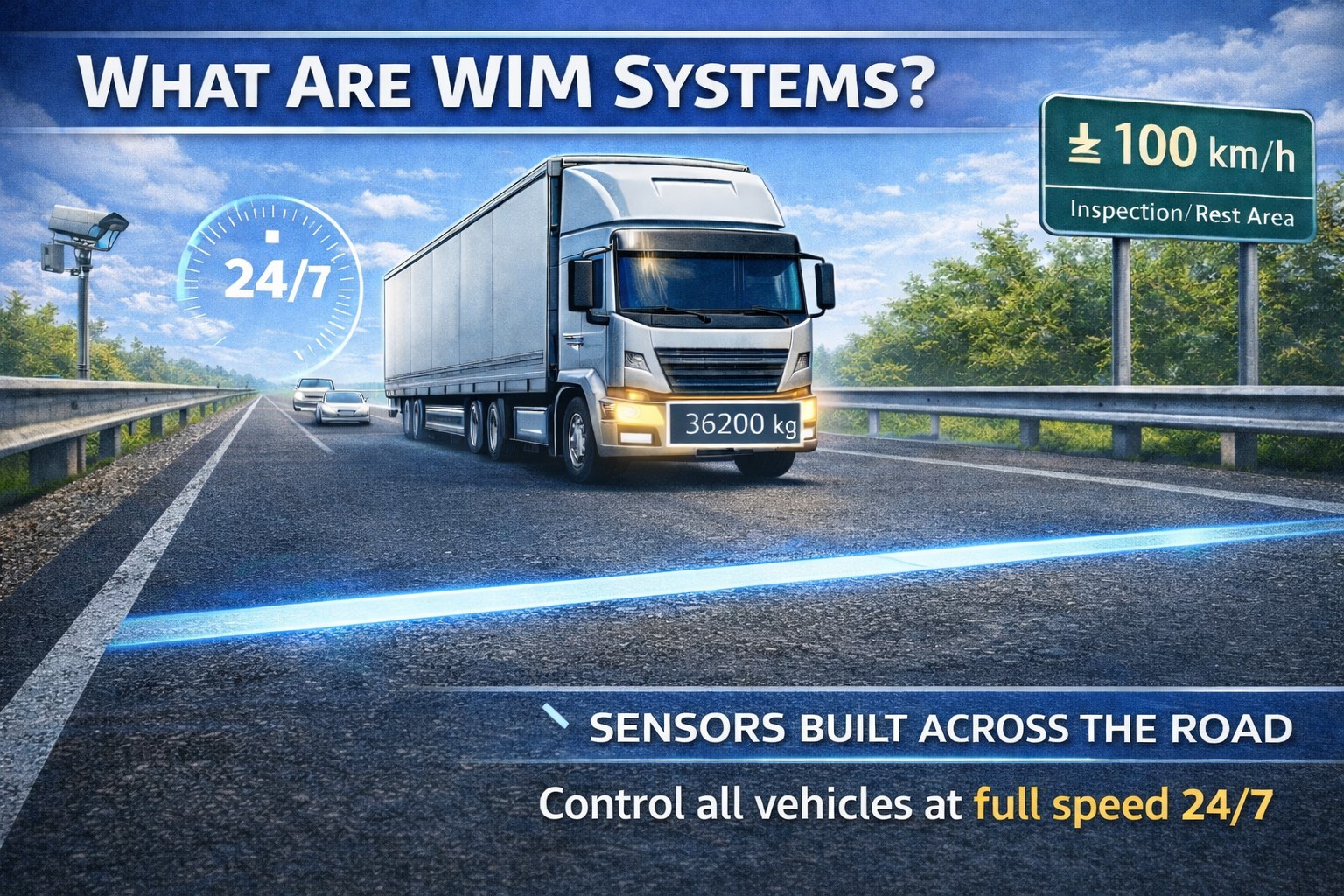
Weigh-In-Motion (WIM) systems are advanced traffic monitoring solutions that allow vehicles to be weighed while they are moving, without the need to stop or slow down. Unlike traditional static scales, WIM systems are installed directly in the road pavement and operate continuously, 24 hours a day, 7 days a week. As vehicles pass over the sensors often at speeds of up to 100 km/h-the system measures dynamic wheel and axle loads and calculates axle loads, axle spacing, vehicle speed, and total vehicle weight in real time. This process is completely automatic and usually invisible to drivers, ensuring that traffic flow remains uninterrupted.
WIM systems are primarily used to protect road infrastructure, improve traffic safety, and support fair and effective enforcement of vehicle weight regulations. Overloaded vehicles cause disproportionately high damage to road surfaces and pose a serious safety risk due to longer braking distances and reduced vehicle stability. By monitoring vehicle weight continuously, WIM systems make it possible to detect overloaded trucks and delivery vehicles before they cause excessive damage or dangerous situations. In addition to enforcement, the collected data is widely used for traffic analysis, pavement design, and long-term transport planning.
Different types of sensors are used in WIM systems, depending on the required accuracy and application. High-precision systems often use quartz sensors, which offer excellent stability, high accuracy, and low sensitivity to temperature changes. Strain-gauge sensors measure pavement deformation under load and provide reliable results at a lower cost, making them suitable for both monitoring and enforcement applications. Piezoelectric sensors are a cost-effective solution commonly used for traffic screening and data collection, although they are more sensitive to temperature variations and long-term aging. Inductive loops are typically installed alongside weight sensors to detect vehicle presence, speed, and axle spacing, enabling accurate vehicle classification.
One of the key challenges in dynamic weighing is the influence of environmental conditions, particularly temperature changes that affect asphalt stiffness. Modern WIM systems address this issue by using pavement temperature sensors installed at multiple depths, weather stations, and advanced self-calibration algorithms that automatically compensate for changing conditions. As a result, reliable and repeatable measurements can be achieved in both hot summer and freezing winter conditions.
WIM systems can operate in different enforcement modes. In traditional applications, they are used for pre-selection, identifying vehicles that may be overloaded and should be stopped for further inspection. In fully automated administrative systems, known as Direct Enforcement, WIM measurements become legally binding. When an overload is detected, the system automatically records the event, identifies the vehicle using license plate recognition cameras, and issues a fine that is sent directly to the carrier, without the need for roadside intervention. Through the combination of advanced sensors, intelligent data processing, and automation, Weigh-In-Motion systems play a crucial role in protecting infrastructure, enhancing road safety, and ensuring fair competition in road transport.
What Are WIM Systems?
Imagine trying to check your body weight not by standing still on a scale, but by running across it. Difficult, right? Now imagine weighing a 40-ton truck travelling at full speed. This is exactly what Weigh-In-Motion (WIM) systems are designed to do.
WIM systems consist of specialized sensors embedded directly into the road pavement. When a vehicle passes over them — even at speeds of up to 100 km/h — the system instantly measures the load exerted by each axle. There is no need to slow down or stop the vehicle.
This technology enables continuous and invisible vehicle weight monitoring, operating 24 hours a day, 7 days a week.
Static vs Dynamic Weighing
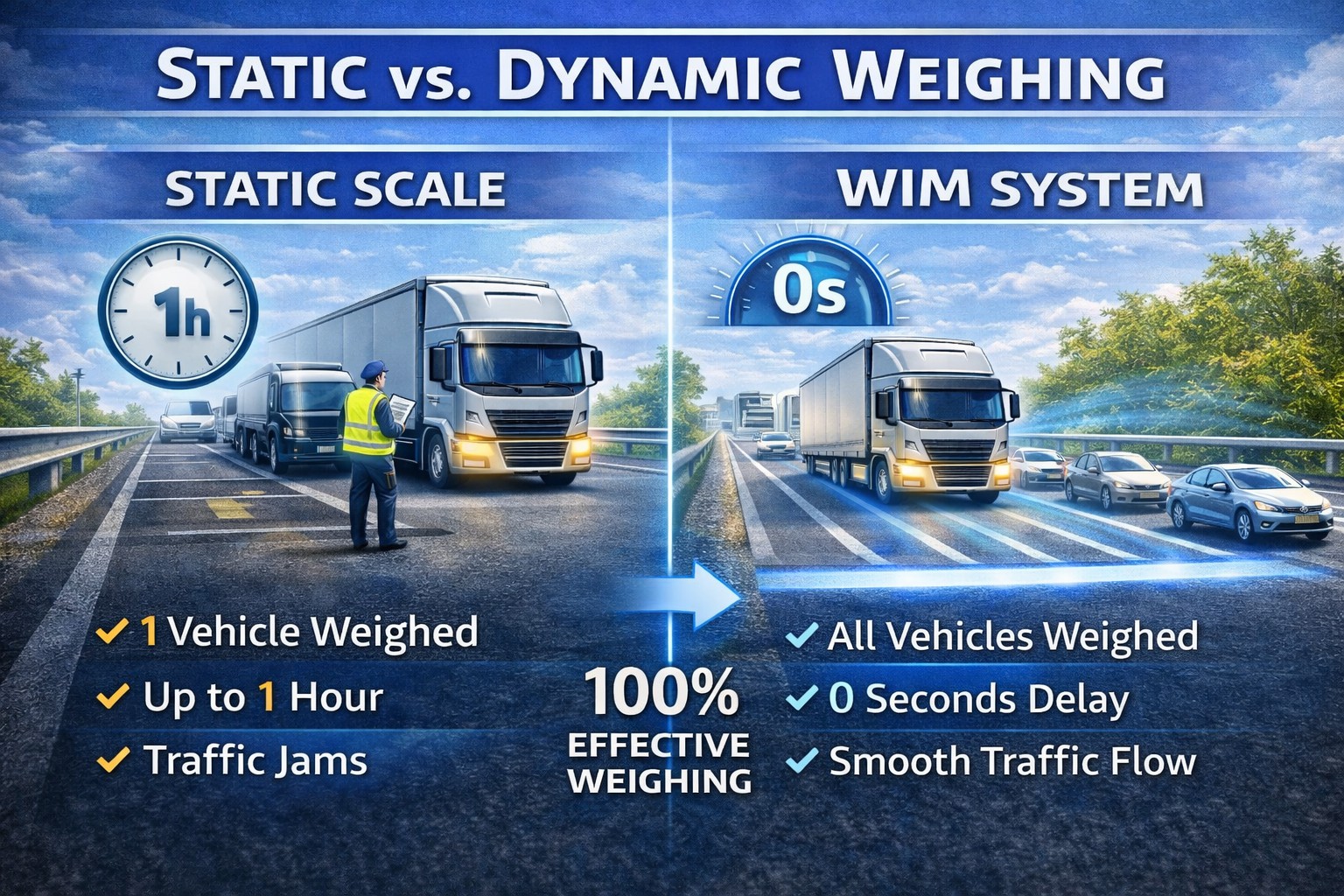
Traditional roadside inspections resemble a game of cat and mouse. Inspectors must select a suspicious truck, stop it, direct it to a parking area, and weigh it using static scales.
Although highly accurate, the entire procedure may take up to an hour. During this time, hundreds of other overloaded vehicles may pass unchecked.
Dynamic WIM systems represent a technological breakthrough, enabling weighing of every single vehicle travelling on a given lane.
Overloaded Vehicles – Invisible Infrastructure Destroyers
Overloaded trucks are silent enemies of road infrastructure. In Poland, approximately 20–25% of heavy trucks exceed legal weight limits.
A single overloaded truck can damage the road surface as much as tens of thousands of passenger cars. Exceeding axle load limits by only 10% can accelerate pavement degradation by up to 50%.
Overloaded vehicles also pose a serious safety risk due to longer braking distances and reduced vehicle stability.

Administrative WIM Systems (Direct Enforcement)
The goal of the AGH and GUM project is the implementation of administrative WIM systems, operating similarly to speed cameras.
- The vehicle passes over WIM sensors embedded in the road.
- The system detects overload.
- A camera captures the license plate.
- A penalty notice is automatically sent to the carrier.
Such systems ensure fairness and eliminate dishonest competition in transport.